
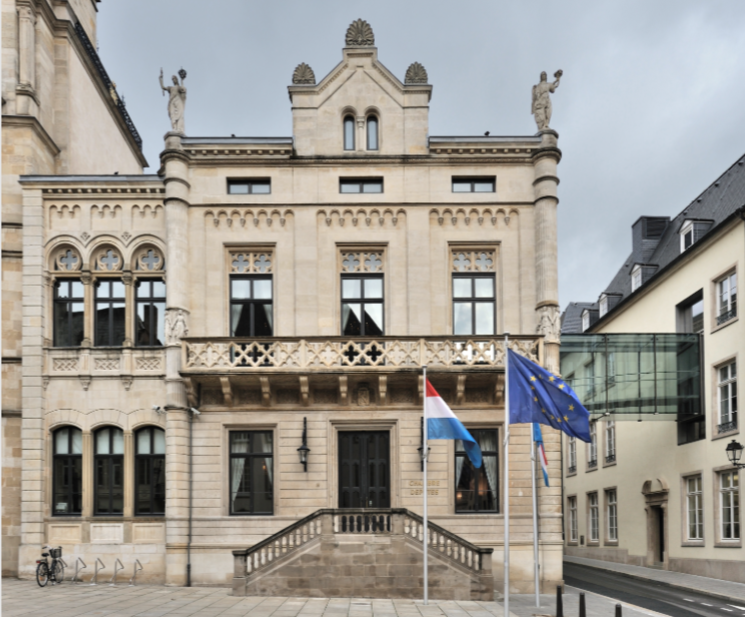
The Luxembourg S.à r.l. share capital reform is now a reality. On 28 April 2026, the Chamber of Deputies adopted Bill n°8669, amending the law of 10 August 1915 on commercial companies. Founders of a société à responsabilité limitée (S.à r.l.) can now defer payment of the EUR 12,000 minimum share capital for up to twelve months following incorporation. The Chamber also granted dispensation from the second constitutional vote, paving the way for swift entry into force.
Why the Luxembourg S.à r.l. Share Capital Reform Matters
Until now, founders had to fully subscribe and fully pay up the EUR 12,000 minimum share capital of a Luxembourg S.à r.l. at the time of incorporation. In practice, this meant founders needed an operational Luxembourg bank account before signing the notarial deed. Given AML and KYC controls, this step often takes at least weeks, sometimes months.
For entrepreneurs, fund sponsors and acquisition vehicles operating on tight timelines, this was a structural friction point. Bill no. 8669 directly addresses it. At the same time, it preserves the legal substance of the minimum share capital requirement.
The New Regime in a Nutshell
The amended article 710-6 of the 1915 Law preserves full subscription at incorporation but allows shares to be paid up within twelve months following incorporation, in accordance with the modalities set out in the articles of association. The articles may provide for a shorter deadline.
Three key carve-outs apply. The following must still be fully paid up at incorporation:
- any amount exceeding the EUR 12,000 statutory minimum capital;
- shares issued in consideration for contributions in kind, together with any related share premium;
- shares issued after incorporation, which must be fully paid up at the time of issuance.
This calibration reflects the policy choice made by the legislator following concerns expressed during the legislative process, notably regarding share premium structuring and the risk of abuse.
Safeguards for Creditors and Minority Shareholders
The amended article 710-7 introduces three protective mechanisms. They preserve legal certainty for third parties and minority shareholders:
- Public disclosure: the company must publish the list of shareholders whose shares are not yet fully paid up, together with the amounts owed, with the annual accounts;
- Joint and several liability: shareholders remain liable for the amount of their shares notwithstanding any contrary stipulation. The new regime imposes joint and several liability between transferor and successive transferees, drawing inspiration from the regime applicable to public limited companies (S.A.);
- Suspension of voting rights: the law suspends voting rights attached to unpaid shares as long as duly called and due payments remain outstanding. The management makes the call for funds.
Notarial Verification and S.à r.l.-S
The notary must still verify the full subscription of the capital. Where applicable, the notary also checks the partial or full payment of the shares and any related share premium at incorporation, and expressly records this in the deed.
The reform also extends to the simplified S.à r.l. (S.à r.l.-S). Under the amended article 720-4, the deferred payment regime applies to the entire subscribed share capital at incorporation. This brings meaningful flexibility for early-stage and start-up structures.
What Founders and Managers Should Do Now
The law must still be promulgated and published in the Journal officiel. Its direction, however, is settled. Stakeholders should:
- Review incorporation timelines to leverage the deferred payment option where strategically useful;
- Update template articles of association to reflect the new statutory framework, including any shorter contractual deadline;
- Anticipate disclosure obligations relating to shareholders with unpaid shares;
- Consider the impact on share transfers of the new joint and several liability regime between transferor and transferee;
- Reassess capital call mechanics at management level, particularly in light of the voting rights suspension.
How Can Lextrust Help?
The adoption of Bill no. 8669 marks a meaningful step in the modernization of Luxembourg corporate law. It strikes a measured balance between operational flexibility for founders and continued protection of creditors and minority shareholders. This reform confirms Luxembourg’s positioning as a competitive and pragmatic jurisdiction for company formation, investment structuring and acquisition vehicles.
Lextrust assists entrepreneurs, fund sponsors, family offices and corporate groups in structuring and incorporating Luxembourg S.à r.l. We draft and update articles of association, and manage the full lifecycle of corporate vehicles.
Our corporate team is monitoring the publication of the final text in the Journal officiel. We will issue a follow-up note on the entry into force and any transitional provisions.
For further information or tailored advice on the impact of this reform on your future Luxembourg structures, please contact:
Jérémie FERRIAN, Partner (ferrian@lextrust.lu)
To read more about Bill no. 8669: https://www.chd.lu/fr/dossier/8669
